
The Intelligence is the Product. Ask ADZA is the Door.
Ask a question the way you’d ask a person, in plain language, and get an answer grounded in OpenTrace’s federated, reconstructed, and confidence-scored intelligence stack. No technical syntax. No dashboard to learn. The evidence behind every answer stays visible.
Why Ask ADZA
Africa does not lack agricultural data. It lacks a way to ask a direct question and get a direct, trustworthy answer back. Ask ADZA does not generate information. It makes information that already exists, and that OpenTrace has already federated, reconstructed, and scored for confidence, usable through a single natural-language interface.
The complexity lives in the data and intelligence layers behind it. The interface stays simple on purpose.
What Ask ADZA Is
- A natural-language interface — Ask in plain language. No technical commands, no query syntax.
- Grounded in a controlled data environment — Every answer ties back to data that has been sourced, processed, and governed on purpose, not generated from open-ended web content.
- Confidence-scored by design — Every response carries an explicit signal for how much evidence stands behind it, and why.
- Built for real decisions — Governments, development organisations, researchers, and private sector actors already use it to explore production, prices, trends, and cross-country comparisons.
What Ask ADZA Is Not
- Not a general-purpose AI assistant — It does not answer any question on any topic, and does not draw on broad, unstructured internet data.
- Not a search engine — It does not retrieve or summarise web pages, and does not scan external sources in real time.
- Not a predictive or advisory tool on its own — Where forward-looking signals are relevant, Predictive Intelligence supplies them, clearly bracketed by confidence. Ask ADZA does not generate forecasts or recommendations of its own.
- Not a data marketplace — It does not aggregate and resell data, and does not collect user data for profiling or advertising.
How Ask ADZA Works
Three layers, from raw data to a plain-language answer.
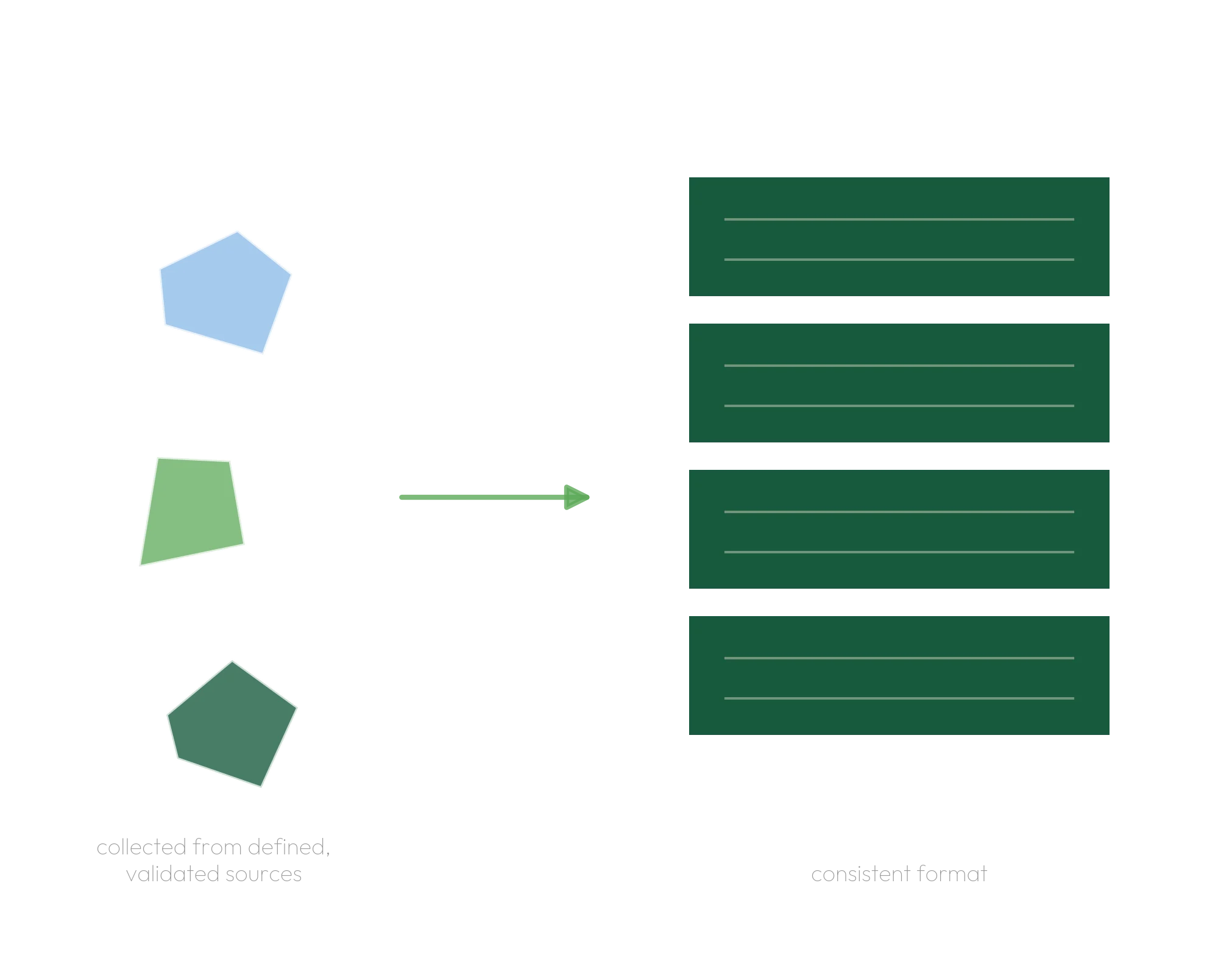
Data Layer
Datasets are collected from defined sources, public institutions, partner organisations, and validated repositories, then cleaned and standardised into consistent formats.
Processing Layer
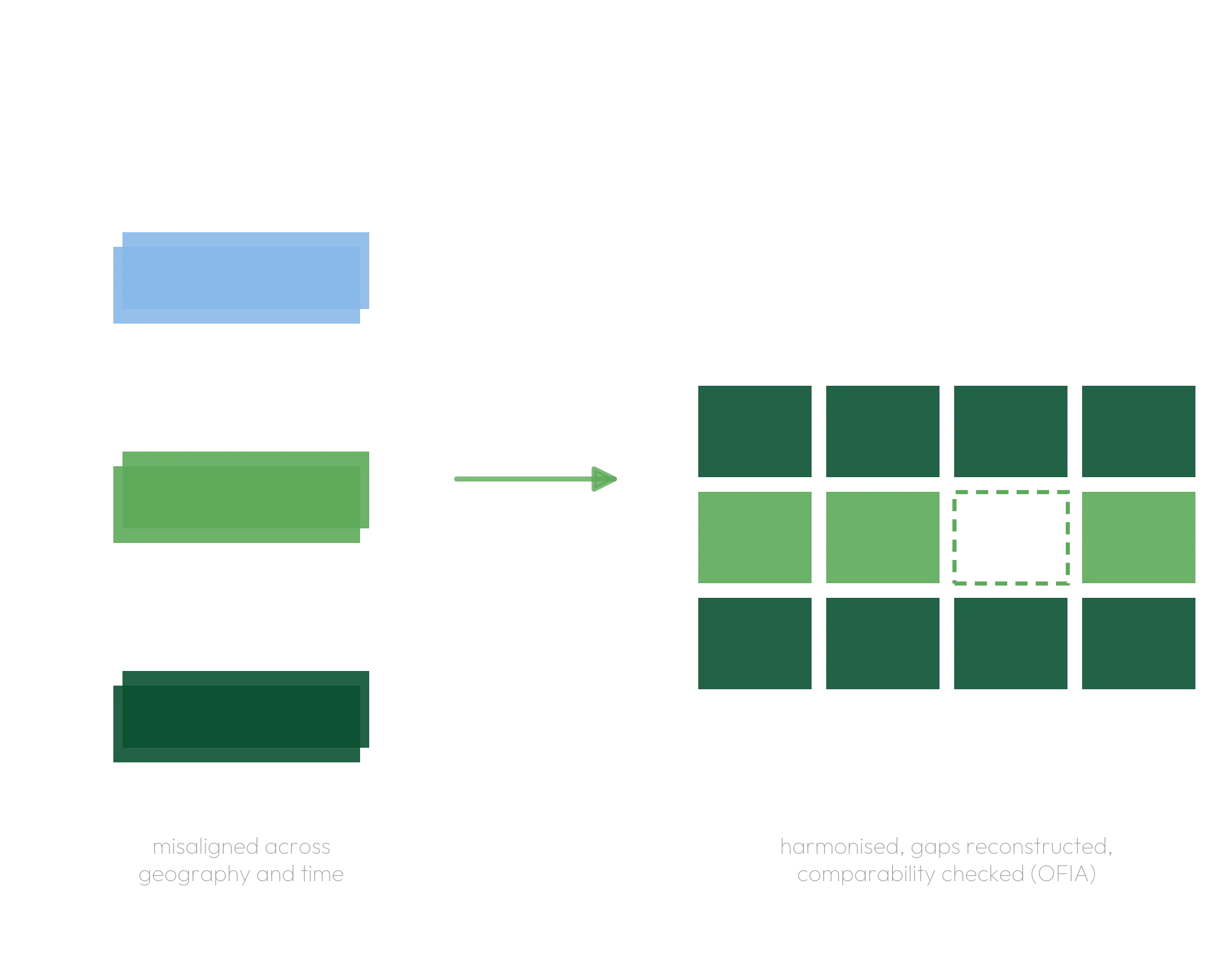
Data is harmonised across sources, aligned across geography and time, gaps handled through Data Reconstruction, comparability checked through OFIA.
Interaction Layer
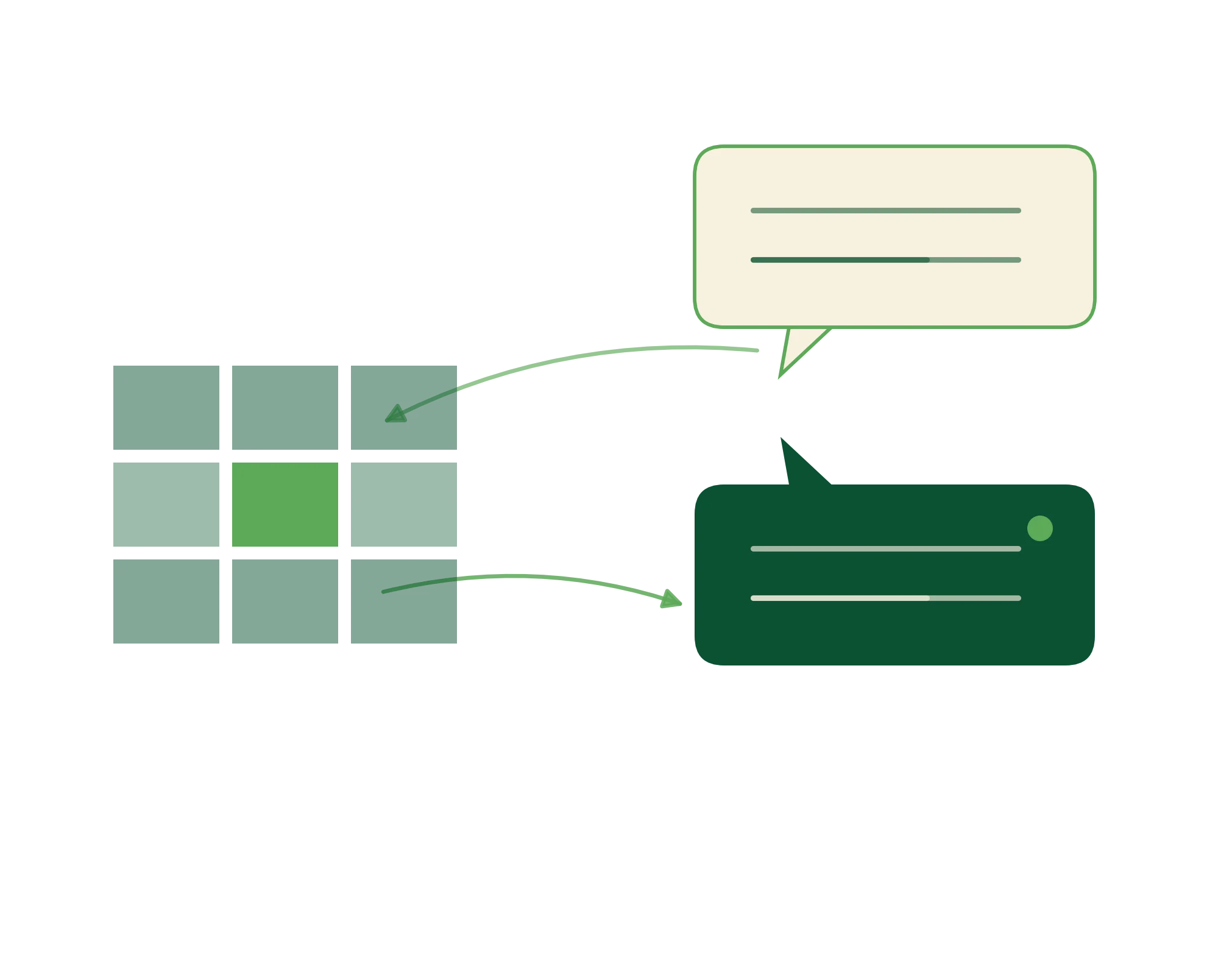
A user asks a question in plain language. The system interprets it, maps it to the relevant data, and returns a response always tied to what’s actually in the federated stack, never generated from unverified sources.
How You Access Ask ADZA
The same intelligence, delivered through whichever channel actually fits how someone works.
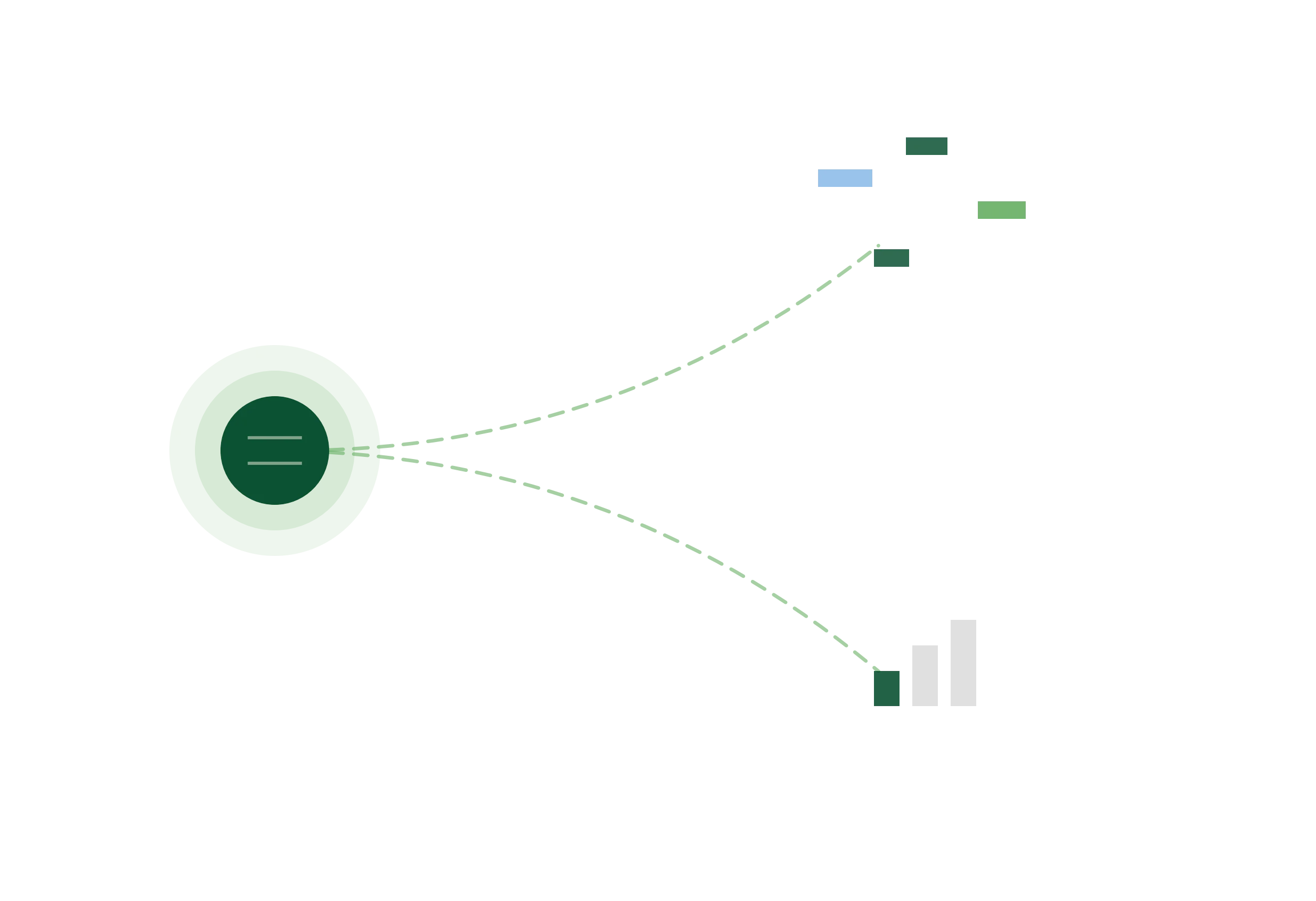
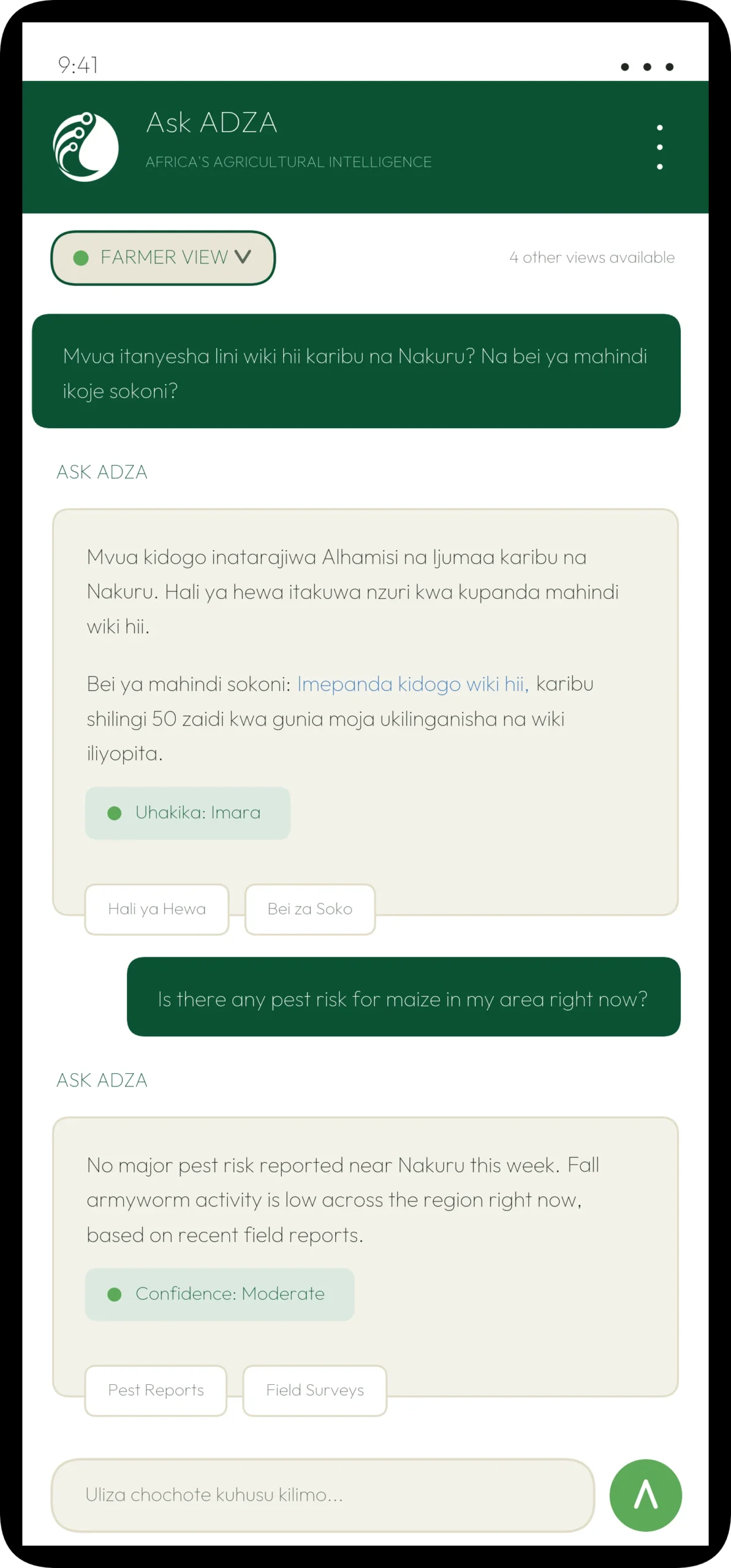
Ask a question in plain language, in a chat you already use. Every answer still carries its confidence tag, even on a slow connection, with no app to download.
Web App
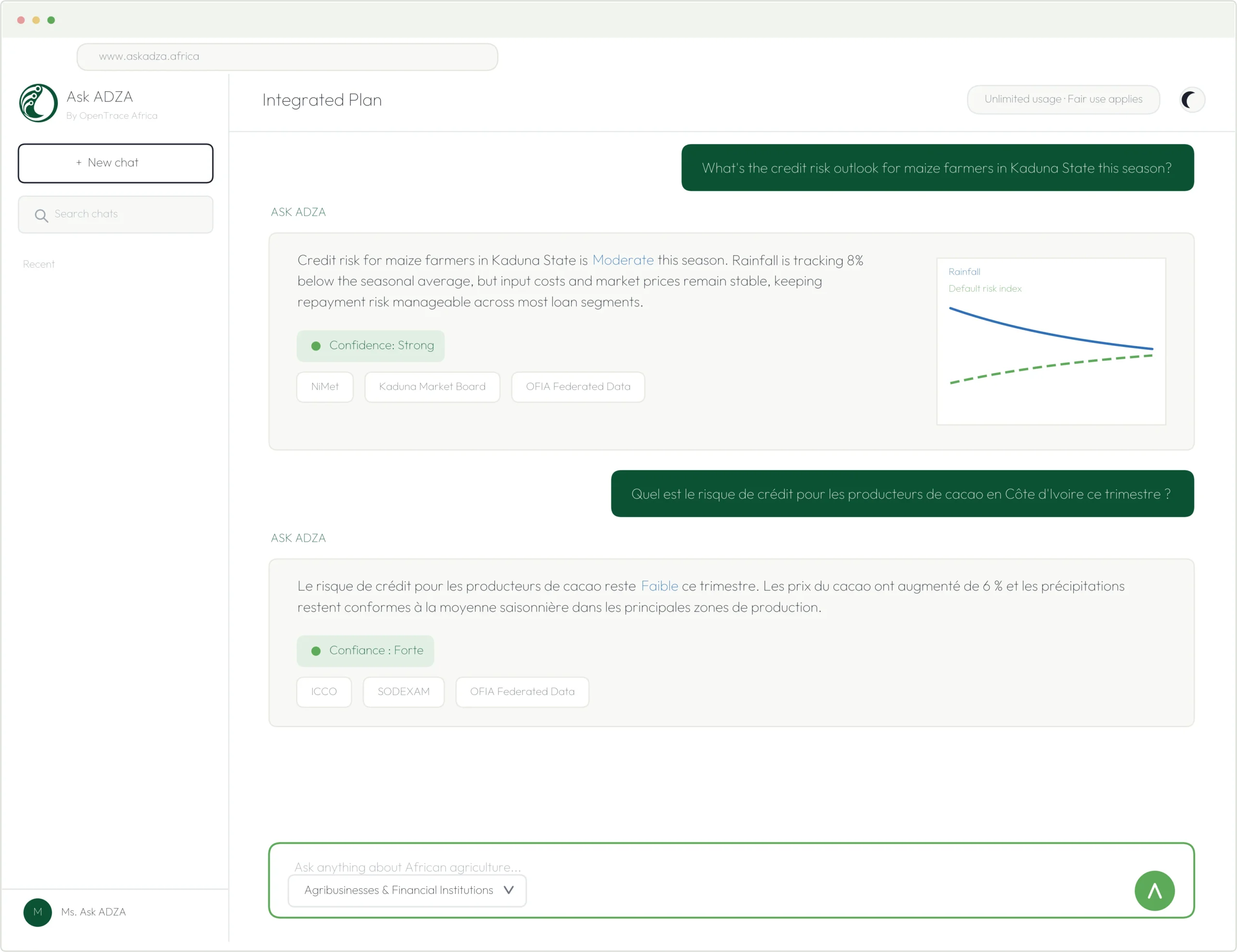
The full experience: ask a question, see the answer alongside supporting charts, and check exactly which sources it draws on, all in one view.
Enterprise API
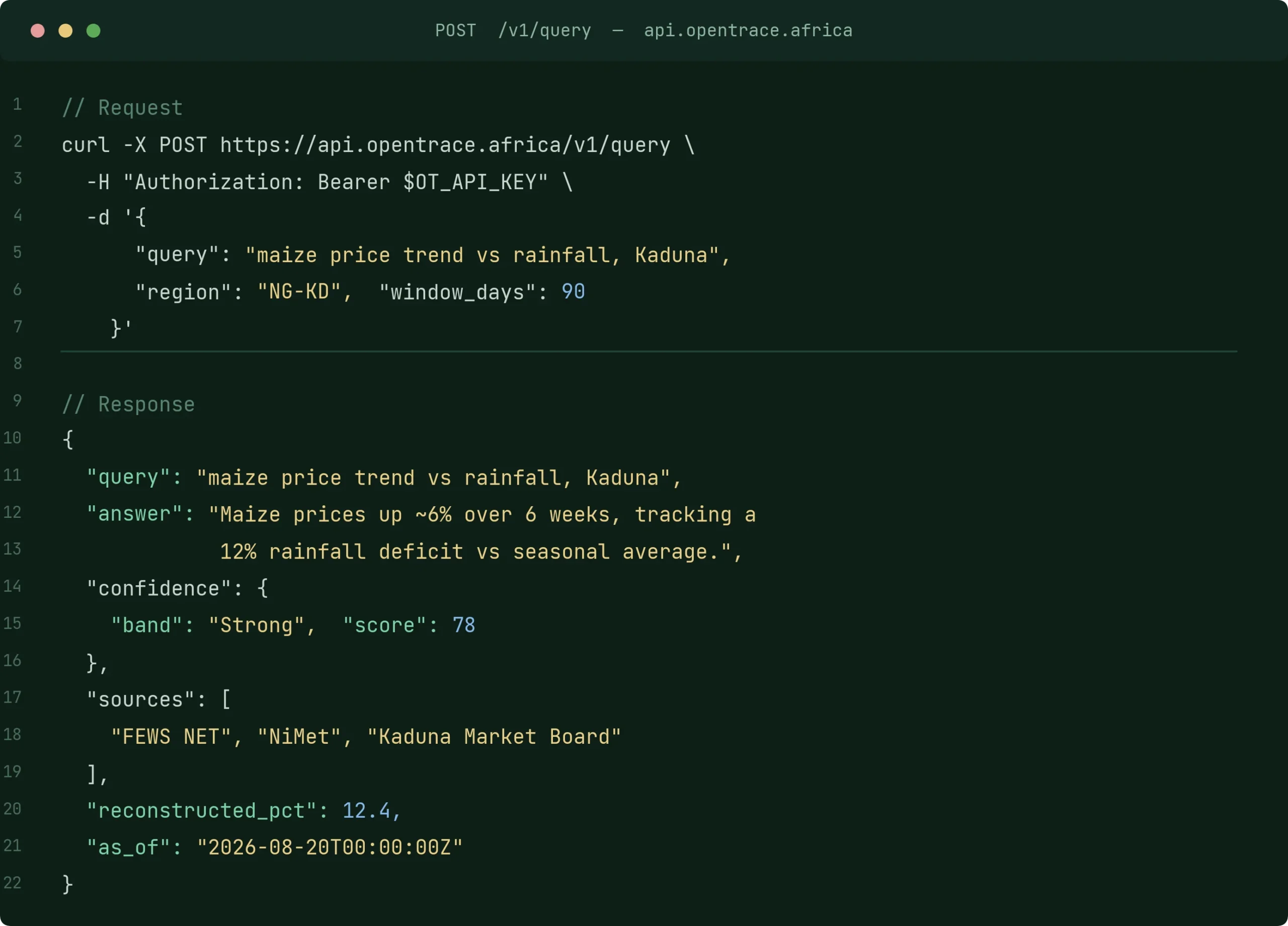
Pull Ask ADZA intelligence directly into your own systems and dashboards. Every response returns as structured data, including the confidence band, the score, the sources, and how much of the answer was reconstructed rather than directly observed.
Every Answer, Explained
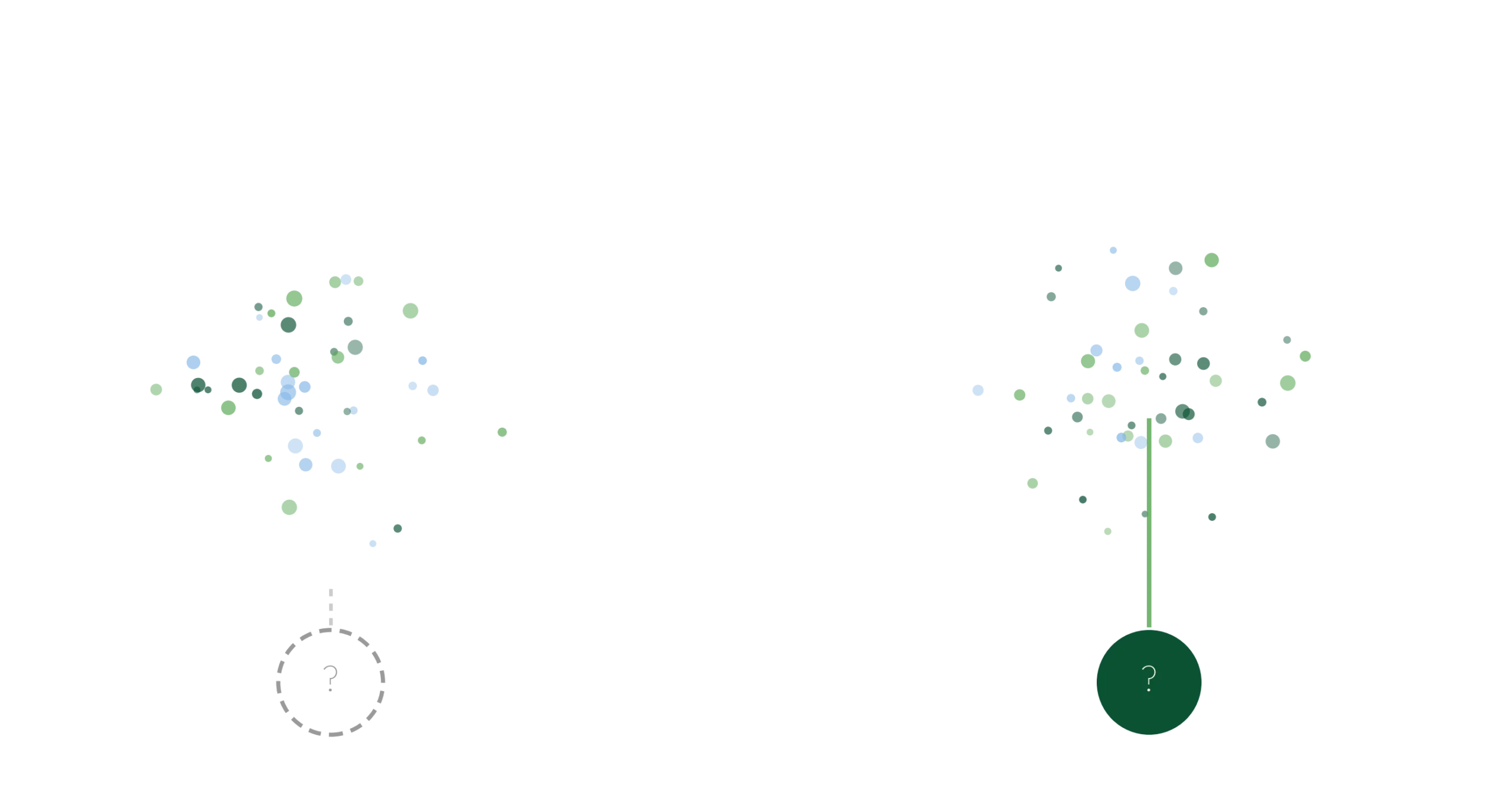
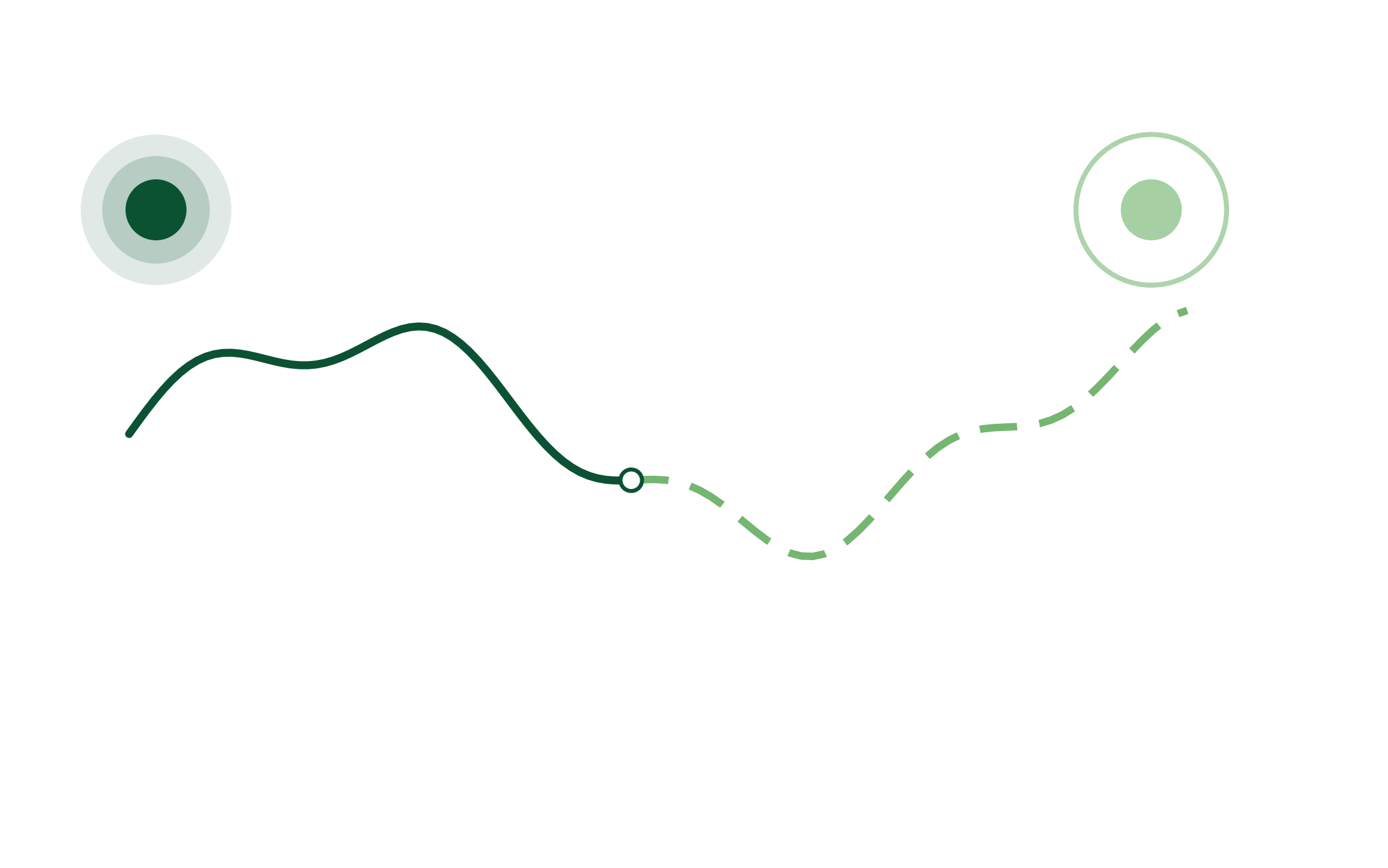
Not every answer comes from complete, directly observed data. Where gaps exist, Ask ADZA draws on Data Reconstruction, structured methods that mirror how agricultural systems actually behave, not statistical guesswork. Reconstructed values are never presented as equivalent to raw, directly sourced ones.
- Raw data — Directly sourced, minimal transformation, higher confidence where coverage is strong.
- Reconstructed data — Built using defined methods where data is incomplete, always interpreted with an understanding of its limitations.
Every response carries its confidence level plainly, not buried in a footnote. That’s the ADZA Confidence Model at work, underneath every answer Ask ADZA gives.
Who Uses Ask ADZA
Governments & Public Institutions
Query production, climate, and land-use intelligence directly, without waiting on the next report cycle.
Foundations, NGOs & Development Partners
Get a continuously updated picture of programme conditions, not a periodic snapshot.
Agribusinesses & Financial Institutions
Pull confidence-scored market, supply, and risk signals into sourcing and lending decisions.
Research Institutions & Academia
Query structured, traceable data instead of reconstructing it from fragments first.
Farmers, Cooperatives & Communities
Ask a plain question in plain language, on a slow connection, and get a plain answer back.
See the full Stakeholders page for what each group gets in depth.
Trained on Africa. Not Retrofitted to It.
Ask ADZA runs on managed language models today. Behind the scenes, we are already building something different, a language model trained specifically on African agricultural, climate, and economic data, grounded in African context from the start rather than adjusted for it after the fact.
Why a Generic Model Isn't Enough
Most language models are trained mostly on data from elsewhere. They produce answers that sound fluent and confident, and quietly miss what matters most here.
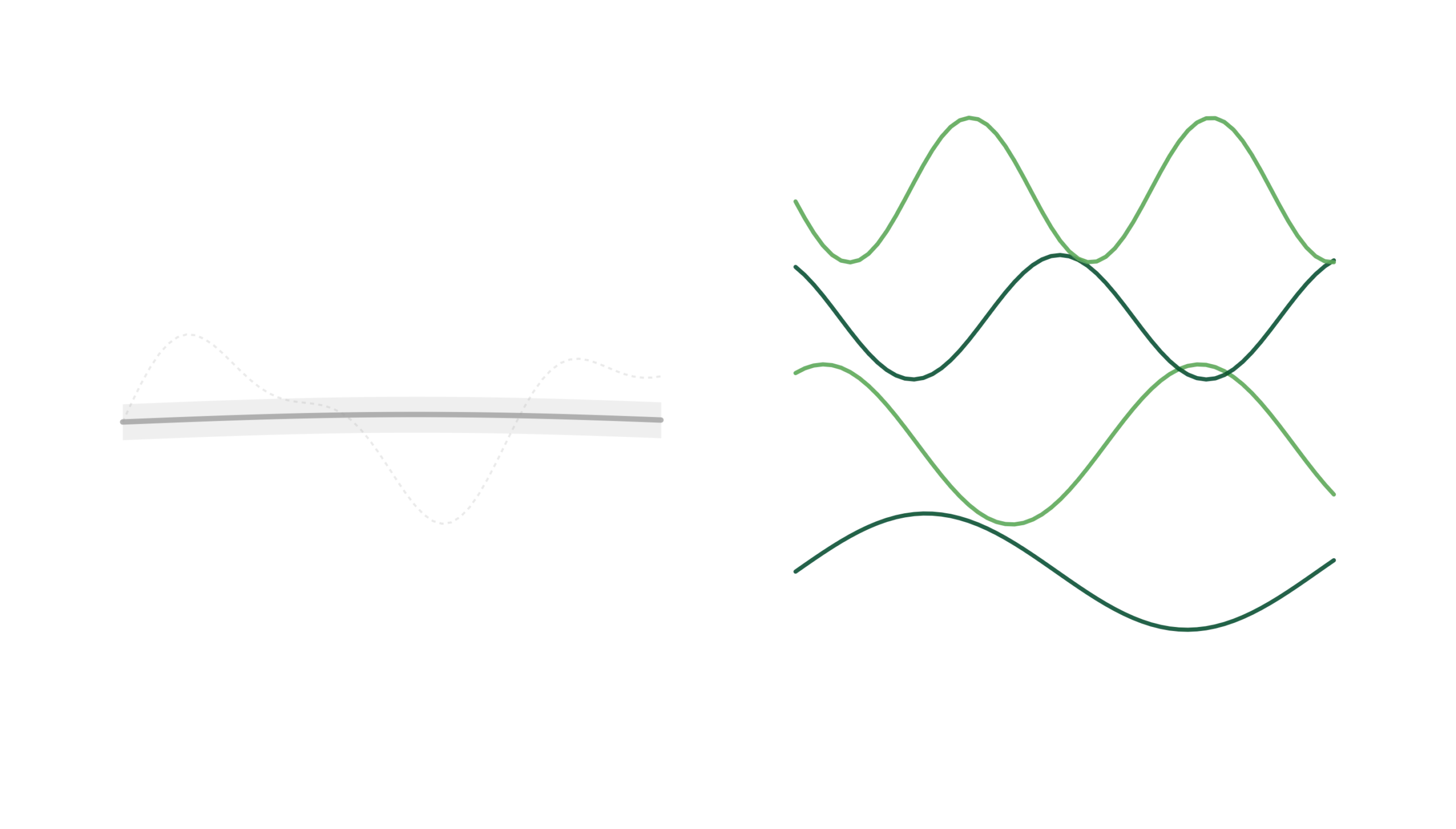
A maize farmer in Kaduna and a maize farmer in Kenya’s Rift Valley face different pests, different soil chemistry, different rainfall patterns, and different market structures, sometimes within the same country, from one district to the next. A model trained mostly on general, non-African data tends to flatten all of that into a single global average. It answers confidently. It just isn’t answering about the place being asked about.
Our model is built the other way around. It learns regional and intra-farm variation directly, instead of smoothing it into one generalised answer.
What “Trained on Africa” Actually Means
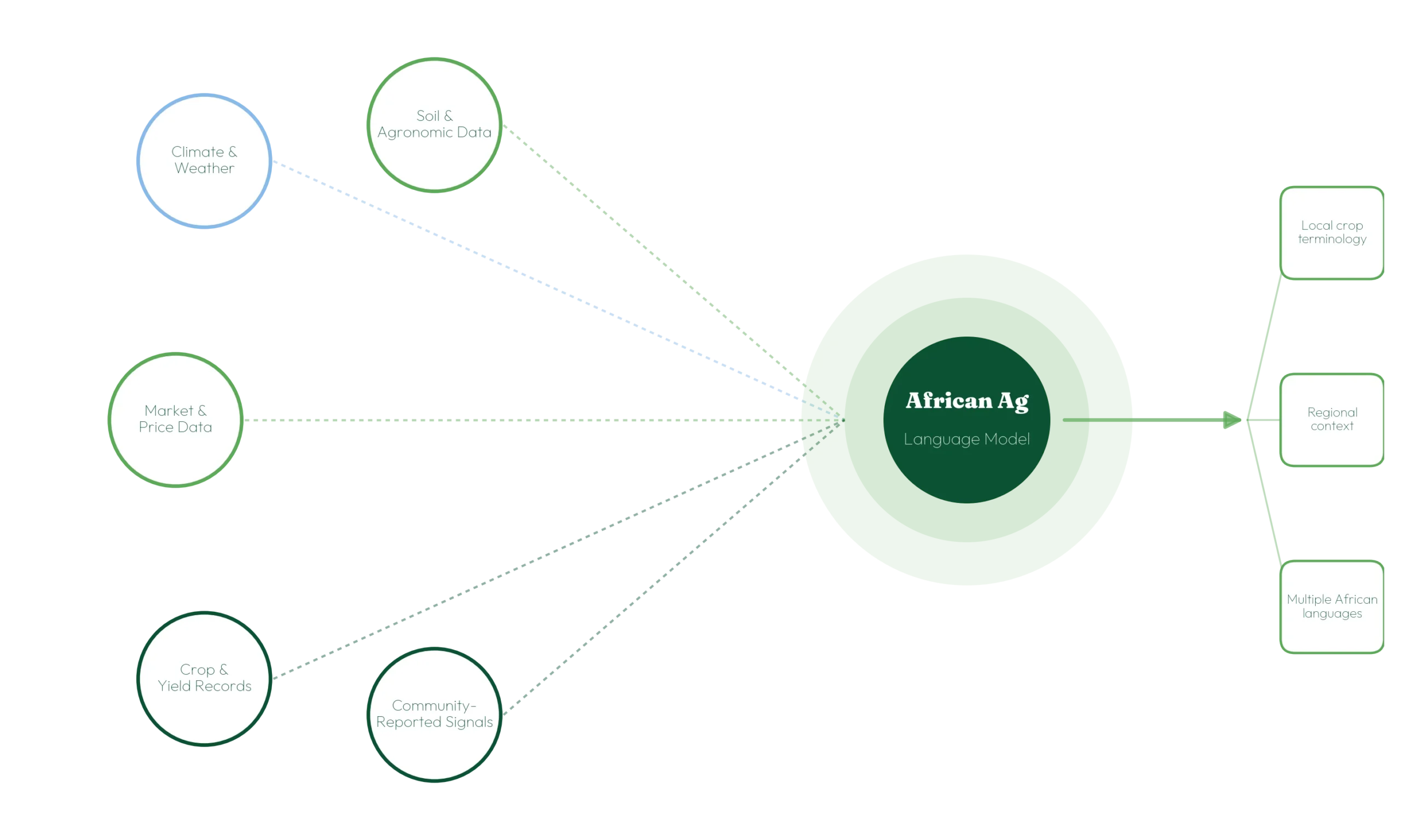
- Grounded from the start — Built on African agricultural, climate, and market data as the foundation, not layered on top of a general-purpose model after the fact.
- Regional and intra-farm variation preserved — The model is designed to hold onto local differences, not average them away for a cleaner-looking answer.
- Local terminology and context — Understands crop names, farming terms, and regional context the way farmers, agronomists, and ministries actually use them, not a direct translation from generic agricultural English.
- Confidence still applies — Fluency is never mistaken for certainty. Every answer the model produces still runs through the same ADZA Confidence Model as everything else on the platform.
Built the Same Way We Build Everything Else
The same principle that governs the rest of OpenTrace governs this too. We do not own the data used to train it. We monetise intelligence, not data.
And the model is held to the same standard as every other output on the platform: validated against real, known outcomes, not assumed correct because it produces a fluent-sounding answer. A model that sounds right and a model that is right are not automatically the same thing, and treating them as interchangeable is exactly the failure mode this platform exists to avoid.
What's Next
- Multiple African languages — Extending Ask ADZA beyond English so the interface fits the reality of who is actually asking, not just who currently has English and broadband.
- Built for low bandwidth — Optimised for the same lightweight channels the rest of the platform already supports, WhatsApp and USSD included, not just a polished web experience.
This work is already underway. We’re not sharing a release date, an architecture, or the specific model it’s built on, that level of detail is part of how we protect what makes this defensible, but the direction is real and already in motion.
HOW TO GET STARTED
Four Simple Steps From Sign-Up to Smarter Agricultural Intelligence.
Create Your Account
Register with your details to create your Ask ADZA account and gain secure access to the platform and its agricultural intelligence capabilities.
Choose Your Plan
Select the plan that best matches your needs and unlock the features, usage limits, and access suited to your organisation.

Complete Your Setup
Complete your account setup and provide the necessary information to prepare Ask ADZA for your agricultural intelligence needs.
Start Asking
Ask questions in natural language and let Ask ADZA analyse agricultural intelligence to deliver relevant, contextual, and actionable insights.